
Following the partition of Ireland in 1921, schools in Northern Ireland came to be divided mainly between de facto Protestant Controlled schools and Catholic Maintained schools. From the 1960s, there were greater calls for integration in education, leading to the creation of a grassroots campaign group called All Children Together.
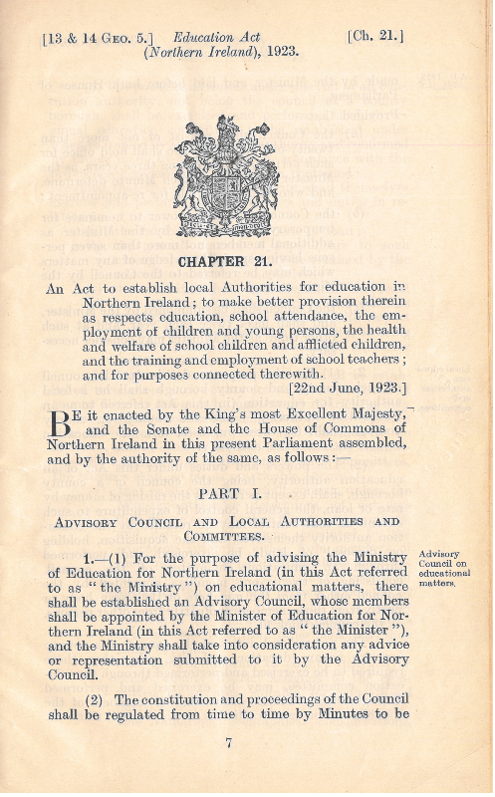
Lord Londonderry, Northern Ireland’s first Minister of Education, introduced the 1923 Education Act, which established the structure of schooling in Northern Ireland. The legislation was subsequently amended and in the following decades, the Church of Ireland, Presbyterian and Methodist Churches largely transferred their schools to state control. Meanwhile, the Catholic Church retained control of its schools. By the outbreak of the ‘Troubles’ in the late 1960s, there were increasing calls to change Northern Ireland’s de facto divided education system.
‘We came over here in 1970 and we were rather shocked by the fact that Protestants and Catholics were separate… we’d just left Tyneside where we had got rid of academic selection. I was really surprised when we put our children into the local primary school and our eldest girl had to do the 11+.’
Anne Odling-Smee CBE, on her reasons for joining All Children Together in the 1970s. She later served as the Chair of the Integrated Education Fund from 1995 to 2000.
In 1972, Cecilia ‘Cecil’ Linehan wrote to the Belfast Telegraph proposing religious education centres to support Catholic families sending their children to non-Catholic schools. Her letter brought together like-minded parents, who organised catechism classes for their children. In 1973, Cecil Linehan and Bettie Benton formed All Children Together, which later became a multi-denominational group.
‘I really wanted to teach, and I really wanted to go back to Ireland… but those two divisions, a sectarian division and the academic selection – how do you decide where you apply for a job if absolutely everything is segregated? Cecil’s letter was a real eye-opener to me.’
Ellen McVea, All Children Together member and former Vice-Principal of Shimna Integrated College.


In 1974, Minister of Education Basil McIvor proposed legislation for ‘shared schools’ to the Northern Ireland Assembly. These plans fell apart when the short-lived Assembly collapsed in response to the Ulster Workers’ Council Strike.
By 1976, All Children Together’s first policy document, ACT on Shared Schools, called for ‘education in Shared Schools acceptable to all religious denominations and cultures, in which the churches will provide religious education and pastoral care’.
All Children Together supported the 1978 Dunleath Act, which allowed schools to transform to Integrated status. By 1981, no schools had successfully invoked this new legislation.
‘The working through of the Dunleath Act went very, very well. The use of it didn’t. It just wasn’t really used.’
Cecil Linehan.
Ongoing violence and a mounting death toll, alongside the hunger strike by republican prisoners, made 1981 one of the worst years of the ‘Troubles’. In the same year, fuelled by the belief in educating children of all abilities and backgrounds together, All Children Together and parents from a range of backgrounds founded Lagan College.
Frustrated by the perceived lack of action by the government and the churches, in March 1981 All Children Together and parents came together to discuss the opening of a new school. In the following months, they named the new school Lagan College, created a draft prospectus and appointed Sheila Greenfield as the school’s first principal.
Lagan College received no government funding and relied on grants from organisations such as the Joseph Rowntree Charitable Trust. Temporary premises were secured at the Ardnavally Scout Centre in south Belfast.
‘That was probably the most significant grant that was made because it allowed the whole integrated education movement to get going.’
Stephen Pittam, former Trust Secretary of the Joseph Rowntree Charitable Trust, on the Trust providing funding for Lagan College.
‘We started from nothing except we had determination and a will to succeed. We had no money, no premises and no staff, just a handful of committed people.’
Maeve Mulholland MBE, All Children Together member and founder parent of Lagan College.

On Tuesday 1 September 1981, 28 pupils arrived at Lagan College. To avoid the press and potential demonstrations, children arrived through the back entrance, and the grounds were patrolled by the Royal Ulster Constabulary.
The premises were basic, and classrooms were cleared at the end of each day for use by the Scouts in the evening. Most families paid modest fees to attend the school, with bursaries provided for those in need.
‘The students sensed, I think, that there was a lot riding on this.’
Brian Lambkin, founder teacher and later Principal at Lagan College, recalling the first day at Lagan College.


In early 1982, Lagan College moved to the site of the former Castlereagh Special School. Over the next few years classes were also taught in the Manor House at Cultra and in the premises of the former Malone Primary School.
In April 1984, Lagan College was awarded Maintained status, meaning that its running costs were met by the Department of Education. Even when a new site was found at Lisnabreeny in 1987, fundraising was required for a new purpose-built campus, which opened in 1991.
The school has developed significantly


In 1984, All Children Together was joined by another organisation, the Belfast Charitable Trust for Integrated Education (BELTIE). Later that decade, the sector was strengthened by new legislation and the formation of the Northern Ireland Council for Integrated Education (NICIE).
After establishing Lagan College, many All Children Together members focused on consolidation and securing the school’s long-term success. Anthony Spencer, a central member of All Children Together and founder parent at Lagan College, instead pushed for rapid expansion and formed BELTIE.
BELTIE played a key role in the 1985 opening of both Hazelwood Integrated College and Hazelwood Integrated Primary School, which were officially opened by world-champion boxer Barry McGuigan.
‘We were absolutely mobbed. It was a big deal and there were camera crews from all over the world. And obviously Barry McGuigan was a big deal.’
Patricia Murtagh, founder teacher and later Principal at Hazelwood Integrated Primary School.


‘You were giving up a full-time permanent post for a school that didn’t exist and a school that didn’t have funding. So, it was a bit of a leap in the dark. But it was a once in a lifetime opportunity to reject segregated education and to contribute to building a peaceful society.’
Noreen Campbell, founder teacher and later Principal of Hazelwood Integrated College, and former NICIE CEO.
‘The teachers who made the choice to move out of the system into an integrated school in the early days… I think those are unsung heroes.’
Michael Wardlow, former NICIE CEO.
In 1985, All Children Together supported the opening of Forge Integrated Primary School in south Belfast, which two years later gained Maintained status. All Children Together then supported schools outside of Belfast, such as All Children’s Primary School in Newcastle, which opened in 1986.


More schools opened across Northern Ireland and 1987 saw the creation of NICIE, a central body to promote and support the sector. By the end of the decade, there were ten integrated schools across Northern Ireland, supported by a range of regional trusts.
‘My children were at the cross-community play group and all of a sudden, they were going to have to split from their friends to go to different schools… So, I got involved. All Children Together gave us £1,500 and that’s how we started a school.’
Anne Carr, founder parent of All Children’s Integrated Primary School, Newcastle.

In the late 1980s, Belfast-born MP Brian Mawhinney introduced the Education Reform (Northern Ireland) Order 1989, legislation that placed a duty on the Department of Education ‘to encourage and facilitate the development of integrated education’. This paved the way for more schools to open or transform, and for the sector to expand more systematically. In 1991, NICIE was granted core funding to assist the development of integrated education in Northern Ireland.


More integrated schools opened in the 1990s and were joined by those that transformed to Integrated status. The establishment of the Integrated Education Fund (IEF) provided funding for many schools, and the 1998 Belfast / Good Friday Agreement included a pledge to facilitate and encourage integrated education.
In 1991, after a parental ballot, Brownlow High School became the first post-primary school to transform to Integrated status, becoming Brownlow Integrated College. This process met with opposition, including a pamphlet created by Councillor Fred Crowe, who sat on the school’s Board of Governors. He argued that the ‘Integrated status now being sought by a few misguided do-gooders will in general be divisive and will only emphasize differences.’

‘Brownlow was challenging, definitely challenging, but totally worthwhile… Through that hard work came the commitment to make it work.’
Kevin Lambe, former Northern Ireland Council for Integrated Education (NICIE) Development Officer and founding Principal at Shimna Integrated College.

The IEF was established in 1992 as a charitable foundation to bring together funders and support the growth of integrated education in Northern Ireland.
It received initial backing from the Nuffield Foundation, the Joseph Rowntree Charitable Trust, the European Commission Structural Fund and the Department of Education. From its establishment up until 2026, the IEF has given out £27 million in financial support to integrated schools and groups.
‘The integrated schools had NICIE, but NICIE was very much operational… I felt they needed this independent but supportive source of funding to call on’.
Anthony Tomei, Former Director of the Nuffield Foundation and founding Board member of the Integrated Education Fund.
From the mid-1990s, government policy shifted towards favouring the transformation of existing schools rather than the establishment of new ones. But many people still took huge personal risks to open new schools, which were increasingly reliant on organisations such as NICIE and the IEF for financial and developmental support.
The signing of the Belfast / Good Friday Agreement in 1998 marked a major step forward in terms of peace and reconciliation in Northern Ireland. It states that ‘an essential aspect of the reconciliation process is the promotion of a culture of tolerance at every level of society, including initiatives to facilitate and encourage integrated education and mixed housing’.
‘My parents had voted “yes” to the Good Friday Agreement, to support the deal, and I think they liked the idea of us going to a school that had kids from both sides of the community.’
Stuart Irwin, former pupil at Hazelwood Integrated College.


All Children Together continued to campaign before winding up its operations in 2003. At that time there were 50 integrated schools in Northern Ireland. The number of schools has increased steadily since, and recent significant developments include the passing of the Integrated Education Act (Northern Ireland) 2022.
Throughout the 1990s, All Children Together continued its campaign for integrated education, organising a range of events, seminars, and public discussions. It supported new integrated schools by providing interest-free loans to Ulidia Integrated College and Strangford Integrated College.
In 2001, All Children Together announced its decision to wind up operations. In 2003, it disbanded and hosted a dinner for Sister Anna Hoare, an Anglican nun who moved from England to Northern Ireland in 1969 and became a long-time campaigner and fundraiser for integrated education.
‘After we were able to give the money to Strangford and Ulidia, I think we felt really we had achieved an awful lot, and anything else we had we should make sure we gave it to NICIE, which we did.’
Cecil Linehan MBE, founder of All Children Together.


After 38 years working at Blackstaff Linen Mill, Baroness May Blood MBE (1938–2022) committed her life to promoting peacebuilding and better community relations in Northern Ireland. She co-founded the cross-community Northern Ireland Women’s Coalition, and from 1999 to 2018 served as a Labour peer in the House of Lords. In 2001, the Integrated Education Fund approached Baroness Blood to be a volunteer fundraiser for six months. She remained involved as Campaign Chair until her death, channelling her passion for social justice into the pursuit of integrated education.
‘What May did for the Integrated Education Fund is remarkable… she was prepared to do anything, right up until her passing, to bring things forward.’
Paul Caskey OBE, Chief Executive of the Integrated Education Fund.
‘We were just so delighted and excited to have her here at Fort Hill Integrated Primary School. It was very special… she’s integration royalty.’
Susan Jones MBE, Integration and Community Co-ordinator at Fort Hill Integrated Primary School.


In 2021, Brefne Nursery School became the first nursery school to transform to Integrated status, while Seaview Primary School in Glenarm became the first Catholic Maintained school to do so.
The Integrated Education Act (Northern Ireland) 2022, proposed by Alliance MLA Kellie Armstrong, updated the definition of integrated education and expanded the scope of the Department of Education’s statutory duty. It passed by 49 votes to 38 in the Northern Ireland Assembly, with support from Alliance, Sinn Féin, and the SDLP.
‘We managed to get it past all those stages with a lot of hard work and co-operation with other parties. And now we have the Act instead of a Bill.’
Fiona McAteer, Alliance Party Councillor and Policy and Research Officer for Kellie Armstrong MLA.
In 2025, Scoil na Seolta opened in east Belfast as an independent school, describing itself as ‘Northern Ireland’s first integrated school teaching in Irish’.
‘We want to be a Grant Maintained Integrated school. We want to be part of the statutory sector, to be a funded school.’
Linda Ervine MBE, Turas and Scoil na Seolta founder.
From the first 28 pupils who started at Lagan College in 1981, there are now over 28,000 pupils in 76 government-funded Integrated schools across Northern Ireland.
The latest data from the Northern Ireland Life and Times Survey shows that 51 per cent of Northern Ireland’s population say they would prefer to send their child / children to an integrated school.
‘We want to provide the best teaching and learning… The fact that we are an Integrated school is our cherry on top of the cake.’
Mark Weir, founding teacher and Vice-Principal at Slemish Integrated College

Data from the 2025 Northern Ireland Life and Times Survey.
As part of this project, we asked a wide range of people to attend community engagement workshops and share their views on the past, present and future of integrated education. Discussion points included access to integrated education; the balance of pupils from different religious backgrounds; recent decisions made on the status of Bangor Academy and Rathmore Primary School; the role of schools in peacebuilding and contributing to a strong civil society; and the perceived success of integrated education in promoting greater understanding and reconciliation in Northern Ireland. Here is a selection of contributions made by community engagement participants:
‘I think integrated education is a very important option for parents who want their children to grow up alongside people from all backgrounds and perspectives, learning to respect diversity and build relationships with people they might not agree with.’
‘You can’t understand the story of integrated education without understanding the opposition to integrated education.’
‘Parents and communities have always been, and continue to be, the driving force behind [integrated education].’
‘I send my children to a Catholic school for them to learn the Catholic religion.’
‘The term “integrated” intentionally or unintentionally implies a moral high ground, where disagreeing can make individuals seem unreasonable or “extreme”.’
‘I think that more schools should be integrated and that it should be the norm. You can see there is a clear appetite for it as the current ones are oversubscribed and many wish to convert. Many are already following the principles, and a politician should not be able to stop them if the parents and pupils wish to become integrated.’
‘Some non-integrated schools are basically integrated in the way they act.’
‘Even if you want your child to go through the education system in integrated schools, there are just not enough integrated schools in local areas.’
‘I have a concern that the way that integrated education is structured reflects a NI which no longer exists due to increased secularism, mixed relationships and other factors.’
‘I feel integrated education is an essential component of the school system in Northern Ireland. I feel that if it is to progress it has to be more widespread across Northern Ireland, particularly west of the Bann.’
‘I think all primary schools should be integrated as I think that many parents in the Catholic community use the primary school solely for sacramental preparation which should be a parents’ job and not the job of the school.’
‘There is a long way to go in the integrated sector.’
‘I think integrated education is the only way forward for education in Northern Ireland.’
‘I went to an “integrated with a small i” primary school.’
